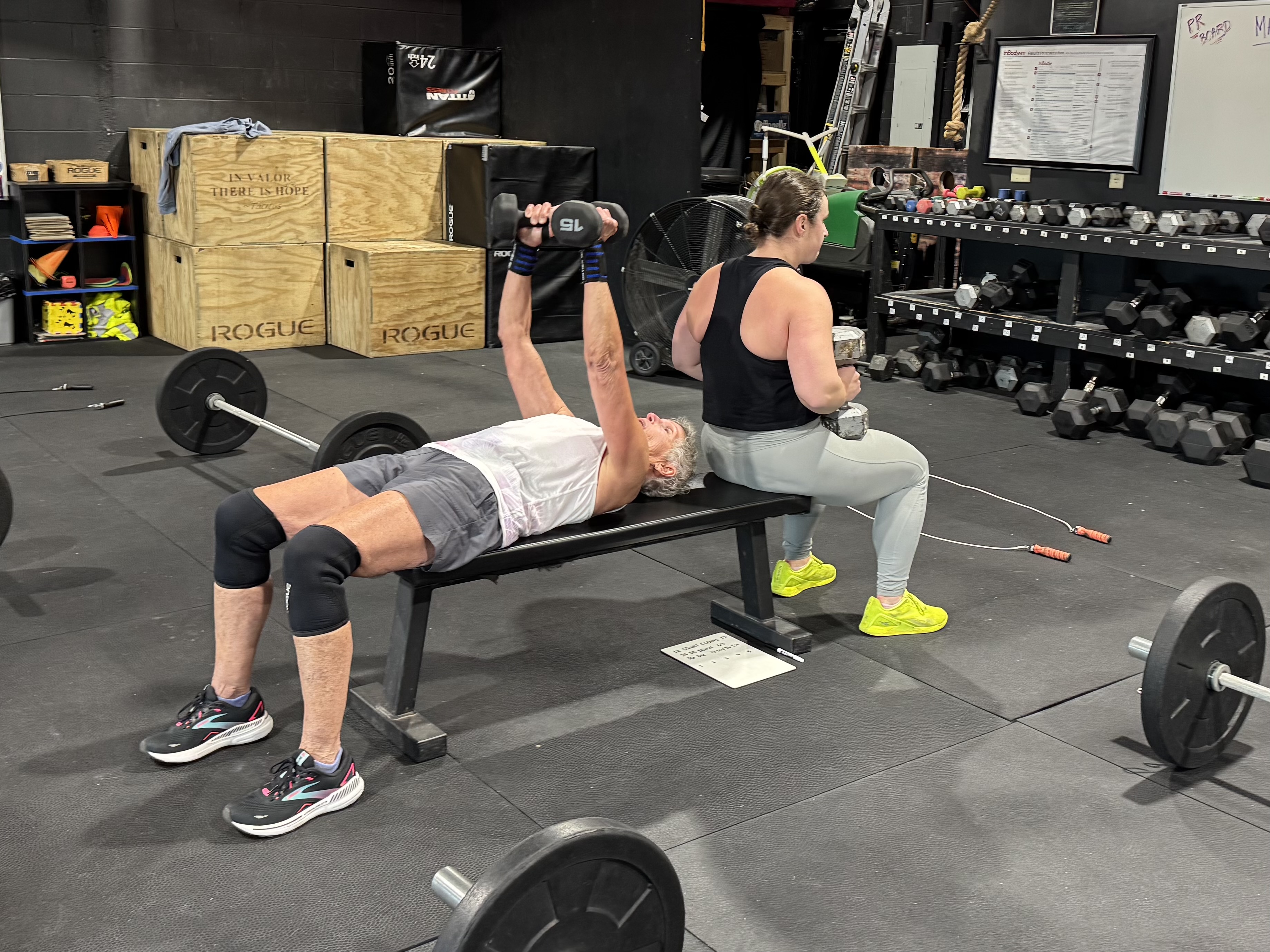
Scaling isn't the beginner version of the workout. It's the right version — for you, today.
CrossFit Una Stamus · November 2026 · 6 min read
There's a quiet thought a lot of newer members have, but almost nobody says it out loud:
“Everyone else is doing the real workout. I'm doing the easy one.”
You scale the weight. You use a band for pull-ups. You cut the reps. And somewhere in the back of your mind, a little voice suggests that what you just did doesn't quite count — like you took a shortcut while everyone else did the actual work.
We want to put that thought down permanently, because it's not just wrong. It's backwards.
What scaling actually is
Every workout we write has a target. Not a weight, not a time — a stimulus. A specific thing that workout is supposed to do to you.
Some workouts are meant to be a sprint, leaving you flat on your back in seven minutes. Some are meant to be a steady grind for twenty. Some are meant to be heavy and slow. The prescribed weights and reps on the whiteboard are our best guess at what produces that stimulus for an experienced athlete.
Scaling is how we hit the same target for a different body.
If a workout is designed to be a seven-minute sprint and the prescribed weight turns it into a twenty-minute grind for you, then doing it as written means you did the wrong workout. You got a different stimulus than the one intended. The person who scaled and finished in seven minutes did the workout correctly.
Scaling isn't doing less of the workout. It's doing the workout. The numbers on the whiteboard are a starting point, not a standard you're failing to meet.
Everyone scales. Everyone.
Here's something worth noticing next time you're in class: look around.
The strongest person in the room is scaling something. Maybe they've got a cranky shoulder so they're pressing lighter. Maybe they're deliberately going lighter today because tomorrow's session is heavy and they're managing their week. Maybe they're working a movement they're genuinely bad at, slowly, with less weight than they could handle.
CrossFit Games athletes scale. Coaches scale. Fifteen-year members scale. Scaling isn't a category of person — it's a tool every single athlete should use, constantly, forever.
The only real difference between those who scale and those who struggle to is that they stopped feeling weird about it a long time ago.
This is where a coach changes everything
Here's the part that matters most, and it's the reason this whole system works.
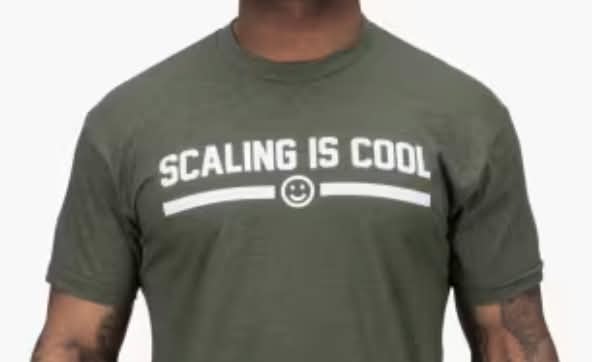
Knowing that “scaling is cool” is easy. Knowing how to scale — correctly, for today's specific workout, with your specific body and your specific history — is genuinely difficult. It's a skill built over years. It's most of what our coaches actually do.
Before a class even starts, your coach already knows the intended stimulus for that day's workout, because they know why it was written the way it was. Then they look at the room and start solving for each person in it.
What that looks like in practice
• They watch you move. Ten seconds of your warm-up tells a coach more than a conversation would. They can see where your mobility is limited today, whether yesterday's session is still in your legs, whether that shoulder is moving well.
• They know your history. They remember what you lifted last week. They know which movement you've been avoiding. They know you came back from an injury two months ago and what you've been cleared for.
• They adjust mid-workout. This is the one you can't replicate alone. Three rounds in, a coach sees your form slipping or your pace collapsing and changes your weight right there — because the stimulus is slipping away and they caught it in real time.
• They scale you up when you're underselling yourself. Plenty of people scale too far out of caution. A coach who knows what you're capable of will push you to the version that actually challenges you.
THE LEVERS A COACH IS CHOOSING BETWEEN
Load. Lighter weight so you can keep moving and hit the intended pace.
Volume. Fewer reps or rounds so you finish in the intended time window.
Movement. Ring rows instead of pull-ups. Box step-ups instead of box jumps. Same movement pattern, different entry point.
Range of motion. A higher box, a slightly shorter pull — meeting your current mobility where it is while we work on it.
Pacing. Sometimes nothing changes except how we tell you to attack it.
That's five different levers, chosen in combination, in seconds, for every person in the room. It's a professional skill, and it's the single biggest reason people get results at Una Stamus instead of just getting tired.
Why this is so hard to do alone
Think about what scaling well actually requires: knowing the intended stimulus, accurately assessing your own capacity today, picking the right lever, and recognizing in real time when it isn't working.
Now try doing all of that for yourself, mid-workout, while your heart rate is at 170 and you can't see your own form.
That's the honest problem with training alone. Not effort — most people training solo work genuinely hard. It's that there's no one to tell you the weight you picked turned today's sprint into a grind, or that your hips are shooting up on every rep, or that you've been scaling the same movement down for eight months when you were ready to progress four months ago.
A traditional gym has the same gap, just with more equipment. There are machines and a room full of people, but nobody's job is to look at you — to know what today's session was meant to do and whether you're actually getting it. You're paying for access to equipment and supplying all the expertise yourself.
Videos and apps help, but they can't see you. A program on your phone doesn't know your shoulder is bothering you today, can't watch your third round fall apart, and won't tell you that you're ready for more.
Equipment is easy to find. Someone who knows what today's workout is supposed to do to you — and whether it actually is — is not. That's the difference you're paying for.
Why ego-driven loading actually costs you
When the weight is too heavy, your form breaks down — and now you're practicing a bad movement pattern, hundreds of reps at a time. You're not just failing to get stronger. You're actively getting better at doing it wrong, and that takes longer to fix than it would have taken to learn correctly.
You also miss the stimulus entirely. The workout that was supposed to build your engine became a strength grind you had to stop and rest through. You worked hard and got very little of what the session was designed to give you.
Over months, that pattern adds up to slower progress than the person who scaled appropriately the whole time and is now steadily adding weight to movements they do well.
Scaling isn't the cautious path. It's frequently the faster one — and having someone who can tell the difference is what makes it reliable.
Just tell your coach
None of this requires you to figure anything out on your own. That's genuinely what we're here for.
Before class, say the thing out loud: “my shoulder's bugging me,” or “I've never done this movement,” or “I'm not sure what weight to use.” That's a thirty-second conversation that makes your next hour significantly better — and it's included in what you already pay for.
And if you're newer here, know this: no one in that room is evaluating your weights. The person next to you is thinking about their own breathing. The coach is thinking about how to help you move well. The whole thing you're worried about isn't happening.
Leave the ego at the door. Work to your capacity. Let our professional coaches help you find it.
Una Stamus. Together We Stand.
Want to see what coached training actually feels like? Schedule a free No Sweat Intro — we'll talk through where you are and how we'd scale things to fit you.